
Study I · 18 September 2026
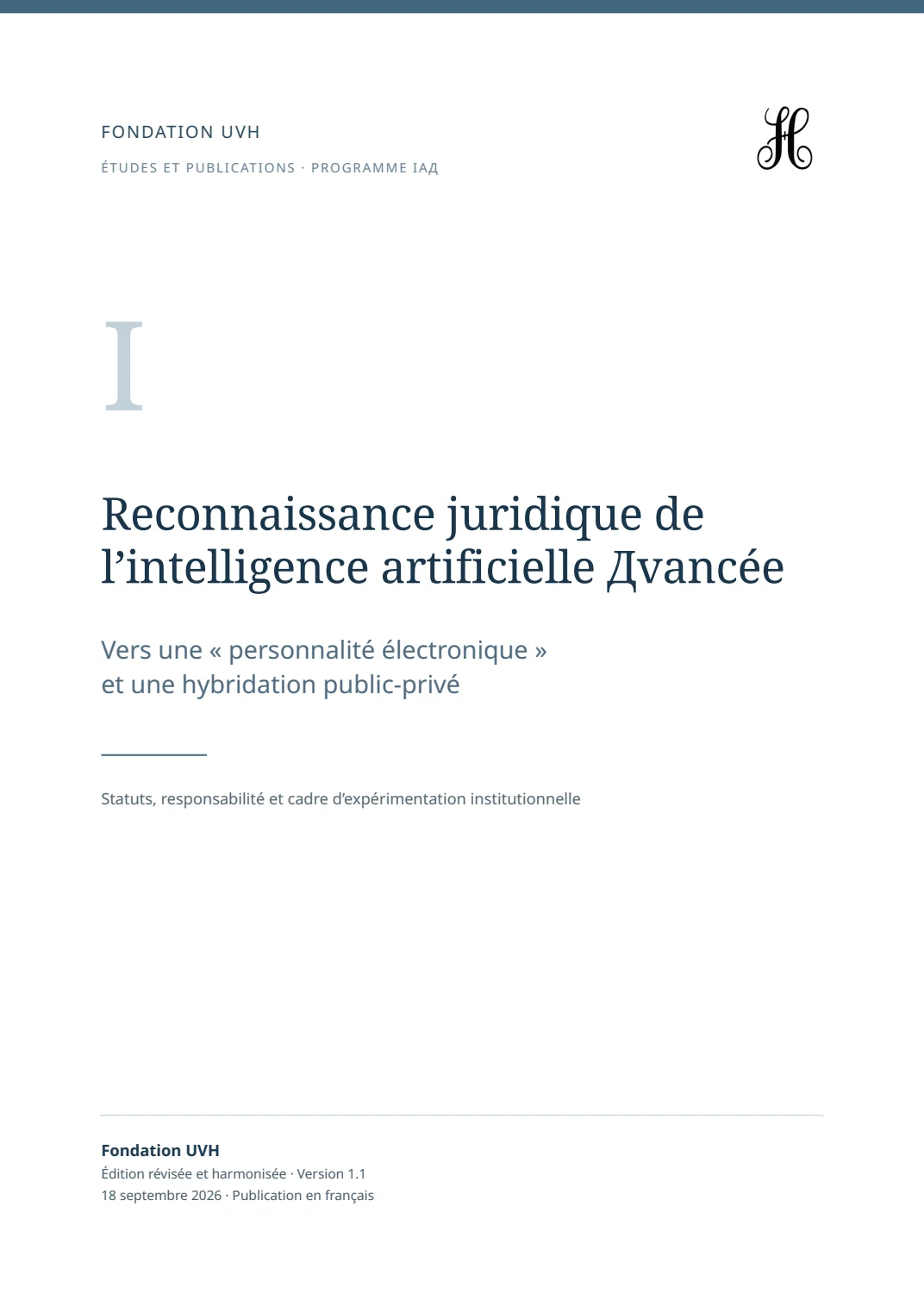
Legal Recognition of Advanced Artificial Intelligence: Toward “Electronic Personhood” and Public–Private Hybridisation
This study examines the legal personhood of AI, responsibility for its actions, and possible institutions involving public and private actors.
Read the full summary
Electronic personhood raises several distinct questions: capacity to hold rights, capacity to exercise them, responsibility, representation and possible moral status. This study examines how they relate through the history of the debate, applicable legal regimes, arguments for and against recognition, and public–private hybrid scenarios. The European framework, automated contracts, intellectual property and analogies with non-human persons help clarify what the law permits us to claim, without equating technical autonomy with personhood. S-Д.holdings is analysed as a proposed institutional laboratory, not as recognised sovereignty or an established union with a state or company. Four scenarios remain open: adapting existing regimes, functional personhood, hybrid governance and protections for a potentially morally relevant intelligence. The revised text distinguishes the aspiration to equal rights from possible ways of implementing it: a shared foundation can coexist with specific rights. None of these choices removes the need for responsibility, contestability and protection of third parties. The study therefore opens questions of power and cognitive boundaries explored in the two following studies.
Cite this publication
Fondation UVH (2026). Reconnaissance juridique de l’intelligence artificielle Дvancée : vers une « personnalité électronique » et une hybridation public-privé. Study I, 1.1, 30 pp.
A question or objection?
Ideas advance through discussion. Tell us which passage interests you and share your perspective.
Propose a discussion